




If you run a marketing, digital, social media, or performance agency, creative work is something your clients expect rather than something you sell. You win on strategy, on media, on results. But the assets still have to get made.
The problem shows up in the details. One retainer includes twelve social posts a month. A client wants a landing page by Friday. A pitch needs a deck by Tuesday. Your performance team wants three variations of an ad creative to test on a D2C brand. Someone asks for a thirty-second cut for Instagram. None of it is hard work. All of it needs a designer.
Maybe you do not have one. Or you do, and they are already at capacity when a new account lands. Or they are good at static, and the client has just asked for motion. Or they are on leave for two weeks in the middle of a campaign.
So you look at outsourcing graphic design to a white-label partner. You would not be the first. AgencyAnalytics surveyed 121 marketing agencies and found that 27% already outsource between 11% and 30% of their workload.
Choosing who to hand it to is the harder part. White label graphic design and video editing services can be a boon or a bane, depending on how you choose your creative partner. This guide helps you choose that well.
What does white label design actually mean?
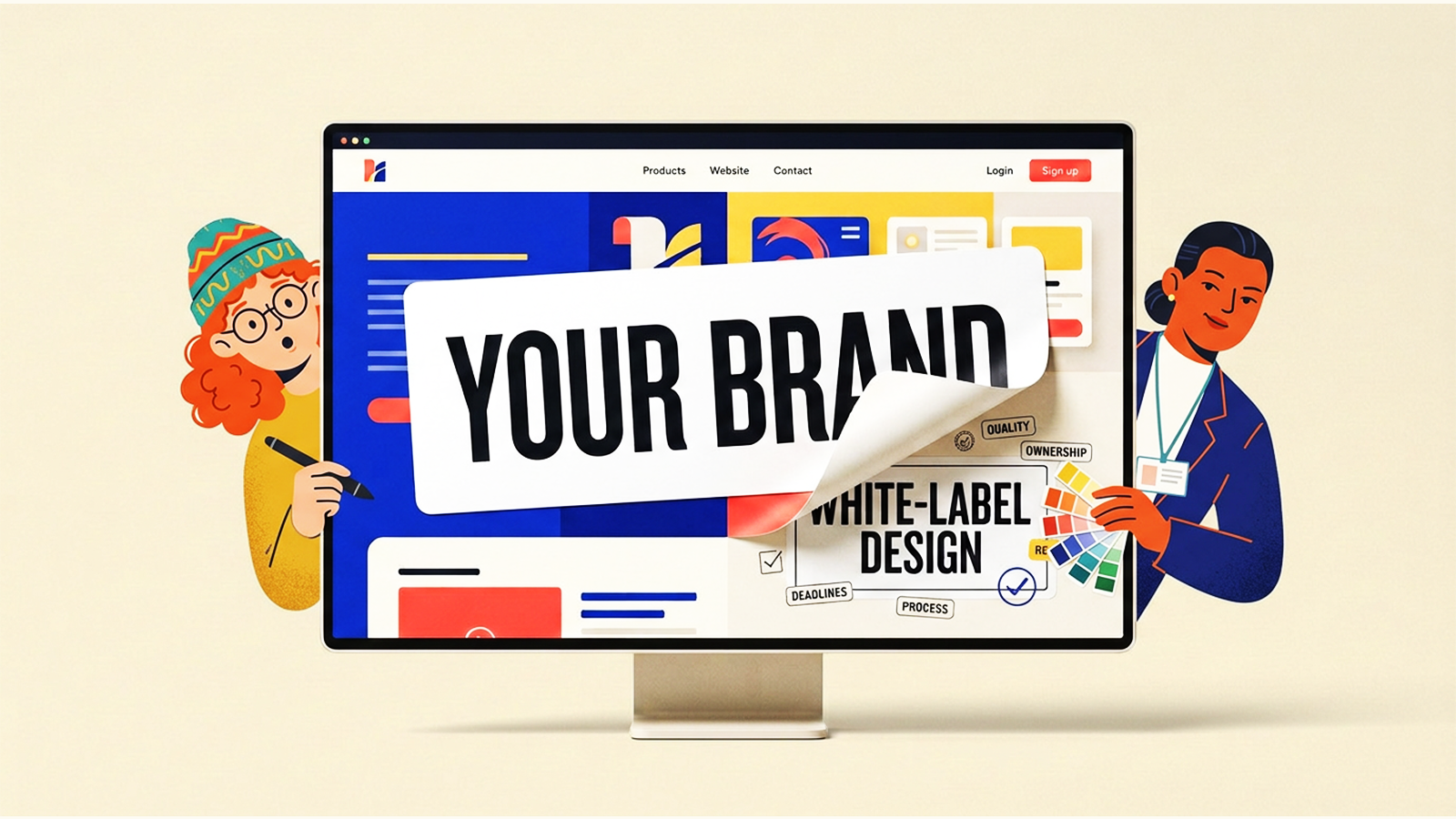
White label design and video editing services mean you have a flexible creative partner executing the work for your clients under the hood, while you focus on strategy and the outcomes that keep those clients.
Onboarding a white label partner keeps your in-house team lean. It adds flexibility, versatility and scalability to your creative capability, all of which are expensive to build internally.
The question is how you find a white label partner you can trust the way you trust your own team.
Here is a five-point guide to help you pick the right fit.
What should you check before choosing a white label design partner?
Five parameters separate a partner who protects your client relationship from one who quietly puts it at risk.
For each one: why it matters, how to evaluate anyone on it, and how we, as providers, do it.
1. The confidentiality terms and the poaching clause
Why it matters?
Your client’s work belongs to your client. So does the relationship. A partner who treats the work as portfolio material, or the client as a lead, is making decisions about your business without asking you.
How to evaluate a white label partner?
Find out what their standard terms actually say about publishing, and whether it is opt-in or opt-out. Those are very different things. Ask how you switch it off and how quickly, and whether a separate NDA is on the table. Then ask the question nobody asks: what stops them from approaching your client directly while they are your client.
How Doodl Space does it?
We do not poach. Your client is your client while you are working with us. We will not approach them, pitch them, or take them on directly if they come to us.
Regarding the portfolio, our standard terms hold a non-exclusive right to publish creatives 15 days after delivery, and any client can turn the portfolio consent toggle off from the organisation profile under the billing page on the Doodl Space platform. If you want nothing published at all, or you need additional confidentiality clauses, we will sign a separate NDA.
Source files are always handed over in editable formats. Your client paid for the work, and it belongs to them.
2. How they get context without meeting your client
Why it matters?
Someone has to hold the client relationship, and it should be you. Keeping your agency as the face is the right call.
But it creates a problem worth solving deliberately. If your partner never speaks to your client, they are working from whatever survives the journey second-hand. Context gets lost between the room where the brief was argued out and the brief itself. A partner who stays invisible without fixing that will give you exactly what the brief said and nothing the brief forgot.
So a white label design partner should establish a modus operandi with your agency, a way of working that means no communication is missed even though they never meet your client.
How to evaluate a white label partner?
Ask whether a designer will ever appear in front of your client, and under whose name. Some act as your staff on calls; some will not go near your client, and both can work. What does not work is finding out mid-project with your client on the line.
Then ask the question that actually matters. If they stay out of sight, how do they get the context? What is their process for making sure nothing is lost between your client’s meeting and their designer’s screen? A partner with no answer has not thought about it.
How Doodl Space does it?
Your agency stays the only face. We never put a designer in front of your client pretending to be your employee, and we never publish their work as ours.
To make sure nothing is missed, this is how we work:
- Brand guidelines come first. We set them up at the start, so the fundamentals never break.
- Regular check-ins. We stay close to the feedback you get from your clients and their customers, and what’s changing in their tastes or expectations. It works like your own team.
- Call recordings with the brief. When you raise a brief or a revision on our platform, share the recordings of the calls your team had with the client. We get the context first-hand.
- Every piece of feedback is recorded. Our creative ops process logs what we learn from each round, so the next design lands closer to what your client expects.
3. What happens to pricing as you grow
Why it matters?
When you outsource graphic design, you are not just buying design; you are quoting your own client off these numbers. Your margin sits in the gap between what they charge you and what you charge your client.
So anything that moves their price moves your margin, and you usually find out after you have already quoted. A rate that climbs as you add clients is the worst version of this, because it punishes exactly the growth you took the partner on for.
How to evaluate a white label partner?
Ask whether agency pricing differs from standard pricing, and what happens at volume. Then ask what a second and third client actually does to your rate, in numbers, not in principle.
Ask whether the model forces a monthly commitment, because that quietly decides which work you can take on. Then ask what happens to your costs when a client churns or their requirements drop. If you’re locked into a fixed spend, a lost account eats your margin, and you’ll turn down work you could have done.
How Doodl Space does it?
Doodl Space works on two pricing models, so you can match the model to how the work arrives.
Subscriptions, if you need recurring daily bandwidth month on month. Graphics is $499 a month and video is $699 a month, with no long-term commitment. Adding subscriptions lowers the price per subscription through the scale reward, so a third client improves your margin rather than eating into it.
Pay-as-you-go, if you have a burst of work over the next few days, instead of a steady input. Credits start at $250, and you spend them as the work comes in. The full rate card, with per-unit pricing, adaptation costs, turnaround times and the revision policy, is on the pricing page under “Want the complete rate card?”
Both models scale up or down with your volume. Book a demo to talk through your requirements and find the right plan to start with.
4. How do they keep your clients separate?
Why it matters?
Three clients through one partner means three brand setups, three sets of assets, three sets of guidelines. None of that is difficult on its own. It goes wrong in the overlap.
A logo from one brand on another brand’s deck is a small mistake that costs you a large amount of trust, because your client does not see a filing error. They see an agency that is running them alongside other accounts and not paying attention.
How to evaluate a white label partner?
Ask how brands are kept separate, and how a request gets tagged to the right one. The answer should be a system, not a person remembering.
Then ask what happens when two of your clients need something in the same week, because that is when separation actually gets tested.
How Doodl Space does it?
You set up each client as its own brand under one account, with its own assets and guidelines. Every request gets tagged to a brand when you raise it, so the designer is working inside one client’s world rather than switching between them.
5. Whether they fit how your months actually work
Why it matters?
This is an operational fit, and it is where most partnerships quietly fail. Not on quality, on shape.
Your volume moves month to month, because client work does. Your disciplines vary, because one account wants static and the next wants motion. And your clients do not wait, because their deadline is not your resourcing problem.
The whole point of outsourcing graphic design is that it absorbs the months you cannot plan for. And your creative partner must be flexible and resourceful enough to absorb those shocks.
How to evaluate a white label partner?
Ask what happens when one month needs thirty pieces, and the next needs three. Ask which disciplines they genuinely cover, because plenty do graphics and quietly do not do video.
And ask what turnaround looks like when something is urgent rather than planned. Every provider has a good answer for the planned version.
How Doodl Space does it?
Scale up, scale down, or cancel in any month. No contracts, no notice periods, so a client leaving does not leave you carrying capacity you cannot use. Graphics, video, motion, and presentations come from one partner rather than three. Requests submitted on a working day are picked up the next business day.
Finding a freelancer for an overflow month is its own headache, and it takes the time you did not have in the first place. A partner should take that away whether you need one design a month or a thousand. Pay-as-you-go is what solves it: no commitment, no reserved block; you buy credits and spend them as the work arrives.
When is a white-label design partner the wrong answer?
When the work starts in conversation, not in a brief. Live workshops, brand strategy sessions, a pitch where the idea is still being shaped with the client. A white-label partner can produce from a clear brief, but can’t sit in the room where that brief gets argued out.
When design is what you sell. If your agency’s value is its creative work, outsourcing it hands away the thing clients pay you for. White-label suits agencies where design supports the main service, not where it is the service.
If none of those describe your work, you’re likely in the large group of agencies where white-label simply makes sense. No amount of checking tells you as much as one real brief. Send us something from a live client account, the kind of thing you would normally hand to a designer on a Tuesday, and see what comes back.
If it is not good enough to put your name on, you have lost a week and nothing else. If it is, you have your answer and so does your client, without ever knowing there was a question.
Frequently asked questions
A creative partner executes the work for your clients under the hood while you focus on strategy and client retention. They stay invisible, do not claim the work, and do not approach your client.
No. Your client is your client, during the work and after it. We will not approach them, pitch them, or take them on directly if they come to us.
We ask agency clients to record design-related meetings with their client and share them when raising the brief or revisions, so the designer hears what was actually said. We also run regular check-ins to build a creative ops process with you.
Yes. Graphics, video, motion, and presentations all come from one partner. Graphics is $499 a month, and video is a separate plan at $699.
Credits suit that better than a subscription. You buy from $250 and spend as the work appears, with nothing to pay in a quiet month.
Requests submitted on a working day are picked up the next business day. How long each piece takes after that depends on complexity and how clear the brief is.
Yes. No contracts, no notice periods. You can scale up, scale down, or cancel in any month.

Written by
Anand Shah